Ben Carter · 5 September 2026
Innovative Approaches to Teaching Kirchhoff's Laws Using Interactive Online Circuit Builders
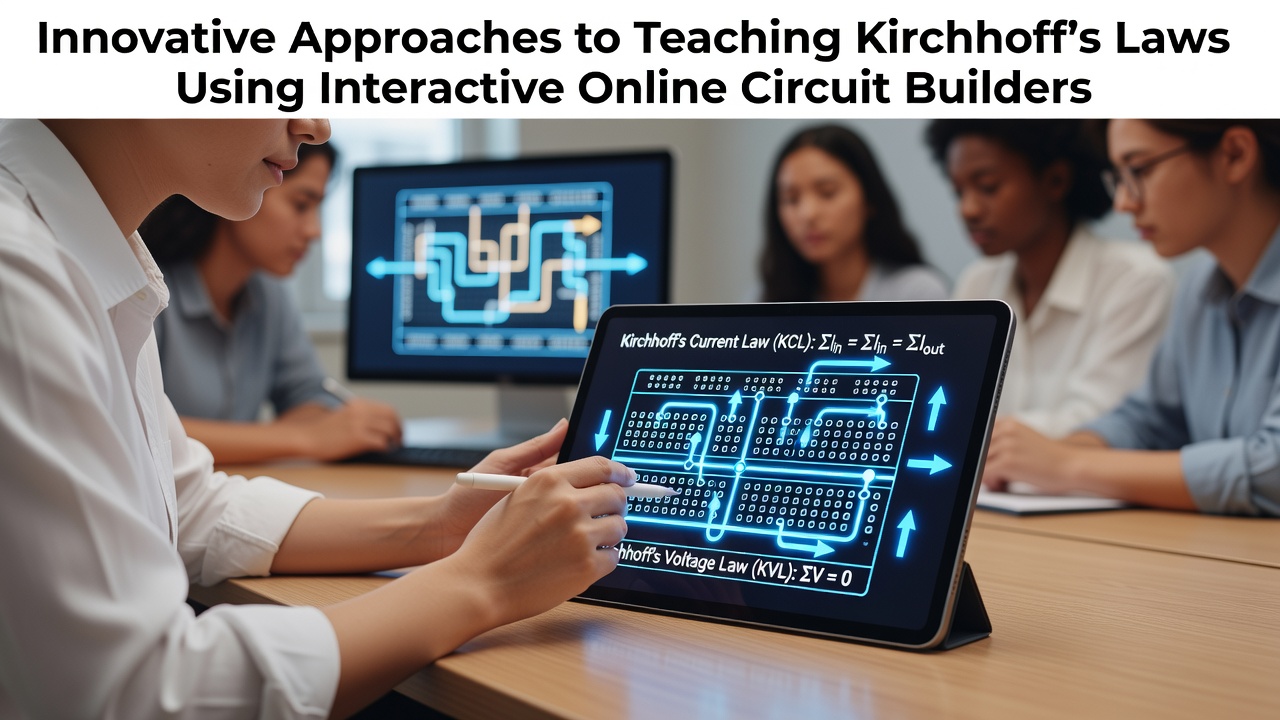
Researchers have documented steady growth in the use of interactive online circuit builders to teach Kirchhoff's current law and Kirchhoff's voltage law, two foundational principles that describe how electrical current divides at nodes and how voltage sums to zero around closed loops. These tools let students adjust component values in real time, observe immediate changes in simulated measurements, and compare results against theoretical predictions without assembling physical hardware each time.
Studies from multiple universities show that students who work with such platforms complete verification exercises faster while maintaining accuracy rates above 85 percent when they later build the same circuits on breadboards. Data collected during the 2024-2025 academic year indicated that institutions incorporating weekly simulation sessions reported a 22 percent reduction in common calculation errors on final exams compared with lecture-only cohorts.
Core Features of Modern Circuit Builders
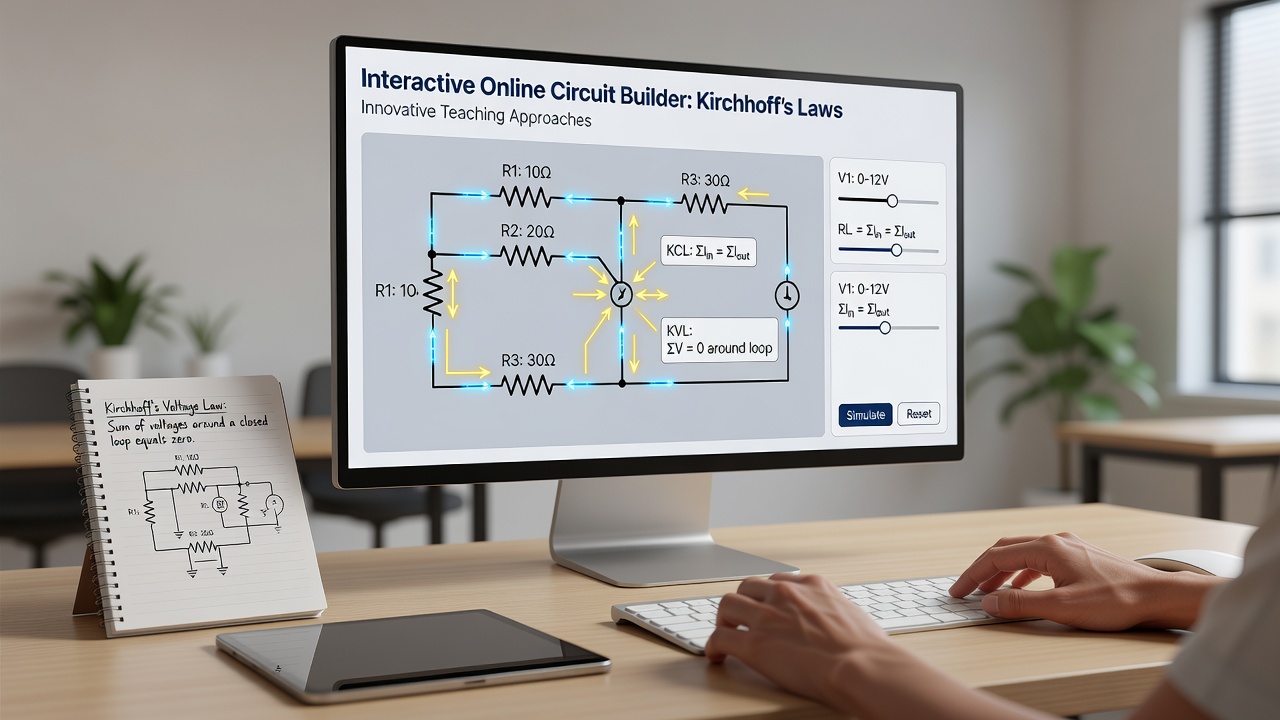
Modern platforms integrate live graphing, multi-meter probes, and automatic law-checking scripts that flag when measured values deviate from expected sums. Users can toggle between schematic and realistic views, add parasitic elements such as wire resistance, and export CSV files of voltage and current readings for further analysis in spreadsheet software. These capabilities allow instructors to design scaffolded activities that begin with simple series circuits and progress to networks containing dependent sources and multiple loops.
Observers note that the ability to pause simulations and step through transient responses helps learners connect algebraic equations with dynamic behavior. In one documented exercise, students set a time-varying voltage source, recorded branch currents at ten-millisecond intervals, and verified that the sum of currents at each node remained zero throughout the cycle. The exercise reinforced both steady-state and time-domain applications of the laws within a single lab period.
Integration into Course Sequences
Curriculum designers at several technical colleges have embedded circuit-builder modules into the first three weeks of introductory electronics courses. Pre-lab quizzes require students to predict voltages using Kirchhoff's voltage law before running the simulation; post-lab reflections ask them to explain any discrepancies between predicted and measured values. Records from these programs show that average quiz scores rose from 71 percent to 89 percent after the simulation component was added.
September 2026 will see the release of updated versions that include collaborative rooms where multiple users edit the same circuit simultaneously, a feature already piloted at two European engineering schools with positive feedback on peer discussion metrics. Instructors can assign roles such as node measurer and loop analyst, then review timestamped chat logs to assess how groups reached consensus on law verification.
Assessment and Analytics Capabilities
Analytics dashboards track how long students spend on each verification step, which nodes they probe most frequently, and whether they correct errors after receiving automated hints. Aggregated data from one North American university system revealed that learners who revisited a circuit more than three times achieved 94 percent accuracy on subsequent paper-based problems involving the same topology. Faculty use these patterns to identify concepts that need additional explanation during synchronous sessions.
Some platforms now export activity logs directly into learning-management systems, allowing automatic grading of simulation checkpoints. A pilot at an Australian polytechnic linked simulation completion data with exam performance and found a correlation coefficient of 0.78 between the number of correctly verified nodes and final course grades.
Supporting Diverse Learning Formats
Hybrid and fully online programs rely on these builders to maintain laboratory continuity when physical access is limited. Remote students receive identical component libraries and measurement tools as their on-campus peers, reducing equity gaps reported in earlier studies of hardware-only labs. Instructors have also created self-paced modules that embed short explanatory videos alongside the simulation window, so learners can watch a derivation of Kirchhoff's voltage law, then immediately test the principle with different resistor values.
Industry partnerships have produced free community editions of several builders, while institutional licenses add advanced features such as SPICE netlist import and export. Government education portals in Canada and the European Union list approved simulation tools that meet accessibility standards, including keyboard navigation and screen-reader compatibility for current and voltage readouts.
Conclusion
Interactive online circuit builders have become a documented component of effective instruction in Kirchhoff's laws across multiple educational settings. Continued platform updates scheduled through 2026 and beyond will expand collaborative options and analytics, giving instructors additional means to monitor student progress and refine activities that connect theoretical statements with measurable circuit behavior.